20
The team
Commonly called “twenty-mule teams,” these outfits often combined eighteen mules and two horses, harnessed together to pull enormous loads.
CHAPTER 01 / THE AGE OF THE OVERLAND TRAIL
The remarkable people, animals and hand-built wagons that helped connect Death Valley to the railroad at Mojave — long before the desert became a proving ground for flight.
Explore the storyDeath Valley to Mojave
Across primitive desert roads
Six years that became a legend
01 / THE ORIGIN STORY
In the 1880s, there were no paved highways cutting through this landscape. To move borax from Death Valley to market, the desert demanded something extraordinary.
At Harmony Borax Works near Furnace Creek, valuable mineral deposits were processed far from the nearest rail connection. Massive wagons pulled by teams of draft animals carried the product over rugged grades and open desert to the railhead at Mojave.
Their success depended on skilled teamsters, durable equipment, water planning and a deep knowledge of the land. It was transportation engineering before the age of engines.
Follow the 165-mile route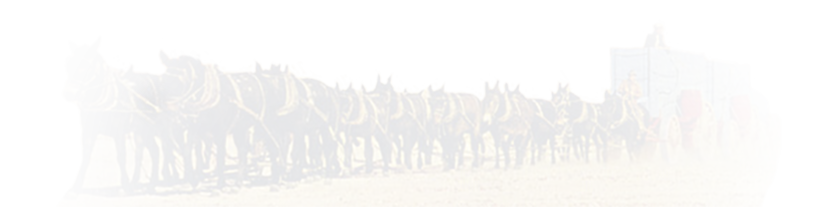
02 / THE ROAD TO MOJAVE
The famous wagons crossed approximately 165 miles from Death Valley to the Southern Pacific rail connection at Mojave. The journey took roughly ten days in one direction — across terrain with little room for error.
Route shown schematically, not to geographic scale. Historic route details: U.S. National Park Service and California State Parks.
03 / THE PEOPLE & THE MACHINE
A complete outfit was an impressive feat of coordination. Every animal, wheel and gallon of water mattered.
Commonly called “twenty-mule teams,” these outfits often combined eighteen mules and two horses, harnessed together to pull enormous loads.
Two huge borax wagons were paired with a water wagon. Their hand-built wheels and frames were engineered to withstand punishing desert trails.
For about ten days in each direction, teamsters guided their animals across long, isolated stretches of desert and mountain country.
04 / PRESERVED IN MEMORY
The great borax-hauling teams operated on the Death Valley route for a relatively brief period. Yet their image became a symbol of the American West — and an enduring part of Mojave's identity.
For the museum, this chapter is more than a story about freight. It is the beginning of a region's long tradition of solving seemingly impossible transportation challenges.
FROM MULE TEAMS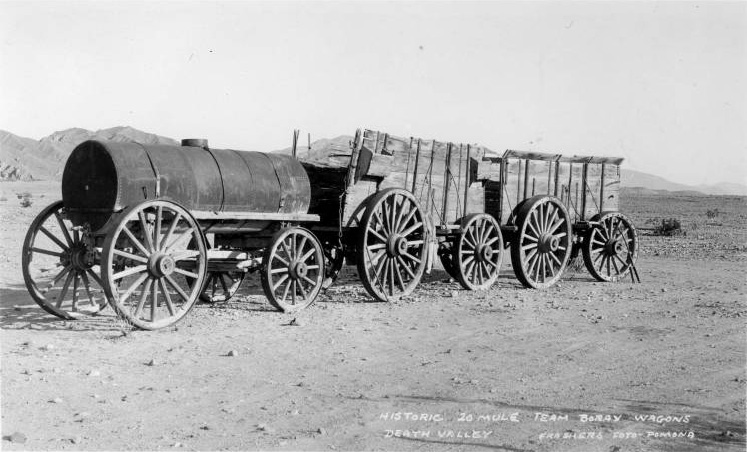
05 / THE PLACE THAT REMAINS
20-MULE-TEAM BORAX TERMINUS
California Historical Landmark No. 652 commemorates the Mojave terminus of the borax wagons. The marker recalls the overland route that brought Death Valley's mineral freight to the Southern Pacific railroad.
Explore the landmarkMojave, California